Spoken Affirmations
Spoken affirmations: why you have to say them out loud
Most people read affirmations. They scroll, they skim, they forget. Breakout is built on a different idea: affirmations work when you speak them out loud and hear your own voice say them. This is the first affirmations app that listens.
The voice in your head runs on autopilot
Researchers in cognitive neuroscience estimate that up to 95% of daily mental activity is automatic. Most of your thoughts, reactions, and self-talk run on patterns that were wired in years ago and have rarely been examined since.
For a lot of people, that autopilot is running negative programs: self-doubt, a harsh inner critic, catastrophizing, the same procrastination loop on repeat. Affirmations are an attempt to change those programs. The real question is whether reading them actually does that.
Reading affirmations quietly does not work
Most affirmations apps are digital quote books. You open the app, scroll a feed, read a few lines, and close it. Nothing changes, because nothing really happened. Silent reading is passive. It asks almost nothing of you, and your brain files it with everything else you scrolled past today.
An affirmation you read is an idea you noticed. An affirmation you speak is an idea you performed. That difference is the entire reason Breakout exists.
Why speaking changes things
When you say an affirmation out loud, several things happen at once. You generate the words yourself. You form them with your body. You hear your own voice make the statement. And for a moment, you are the person saying it.
Speaking is active. It takes breath, attention, and intention. That effort is not a side cost. It is the mechanism.
The science of saying it out loud
None of this is magic. It is the repeatable result of practicing out loud instead of reading in silence. Breakout is built on several well-studied ideas:
- The production effect. Memory research finds that words you say aloud are remembered better than words you read silently, an advantage on the order of 10 to 20 percent.
- The generation effect. Material you generate yourself is remembered far better than material you simply read, and the advantage grows the longer you need to hold on to it.
- Self-affirmation theory. Decades of research, starting with the psychologist Claude Steele, show that deliberate, values-based affirmation can lower defensiveness and open you to change.
- Commitment and consistency. When you say a statement out loud, by choice and with effort, your mind works to bring your beliefs in line with it. Speaking turns an affirmation into a commitment.
- Identity-based motivation. You act in line with who you believe you are, so practicing the belief out loud is practicing the behavior.
How Breakout listens
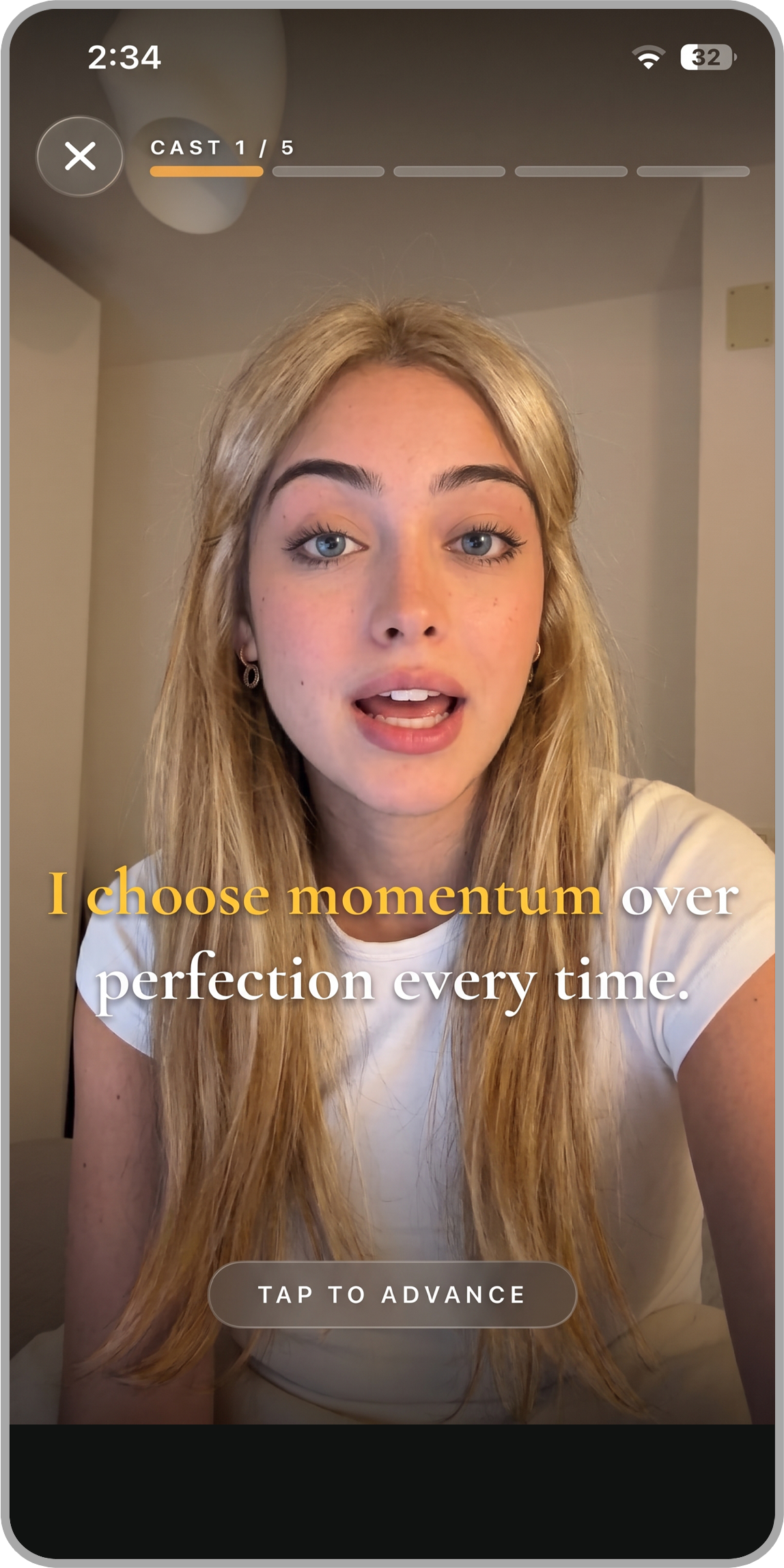
Breakout uses on-device speech recognition. As you say each affirmation, the app listens and highlights every word as you reach it. An affirmation only counts when you actually say it.
This turns a passive habit into an active, verified one. You cannot skim, and you cannot autopilot your way through it. You either said it or you did not. The spoken practice you build inside Breakout is the core of the practice.
The mirror
During practice, Breakout can turn on your front camera as a live mirror. You speak each affirmation into your own reflection and watch the words highlight as they are matched. Speaking while looking at your own face closes the loop between the statement and the person making it. The mirror is optional, and no photos or video are ever captured.
Your privacy
Speech recognition runs entirely on your device. Your voice never leaves your phone. Breakout records no audio and no video, even when the mirror is on. There is no public feed, and nothing is shared. Your sessions, streaks, and affirmations are private to you.